THE POLAR EXPRESS 3D motion capture
THE INCREDIBLES 3D animation
Why does THE INCREDIBLES work and THE POLAR EXPRESS just makes you want to run away screaming? In this study of 3D animation vs. 3D motion capture I will be exploring the two films to find out what makes them come to life!
The first time I watched THE POLAR EXPRESS (Based on the 32-page children's book by Chris Van Allsburg) I was blown away by the visual effects. The artists that produced this film were obviously top class renderers, modellers and lighting technitions. I personally thought that the motion capture worked extreemly well and I couldn’t see it being animated better but after further examination there were some fudemental floors throughout the whole film. The second time I watched the film, the floors became more obvious. At times I felt like I was watching a horror film as the children had creepy and almost doll-like expressions, as if they were hiding something. I don’t know if this is just me being an animator as I know they are not real and are hollow it is almost like they have no soul.
So why did I find the children so sinister? Was it something to do with the actual character design or was it the fact that it was all motion captured?
Before I watched this film I heard rumors that it was animated badly and the story just didn’t work. Because of this I have tried to took at the film in a non biased way to start with. I don’t think that their opinions and statements are completely true as this film is an excellent christmas film that children and some adults would like to watch at this time of year. My girlfriend also watched the film and didn’t see much wrong with it at all which is good as she can advise me and give me critical feedback about the film from a non animators point of view.
Roxanna’s view is that the motion capture worked brilliantly within the film and that there were very few times where the cararcters did not move correctly. She thinks that if the characters were animated like the incredibles she would have disliked the film. At more than one point of the film she felt like that the characters were human instead of CG. She said that the only thing that put the film down were some of the facial expressions.
I can totally see her points about polar express. It was a good film and kept me occupied throughout. I think she has a point about the facial expressions as I didn’t think they captured enough to convince me that the characters were real. The style of this film is photo-realistic but they havent quite managed to do that with the characters. The animated fim The Incredibles is obviously not photo realistic and therefore the actual animation can be more leanient and abstracted and the audience will still think that there is nothing wrong with the animation.
Here is a quote I found in the book “The Art of The Incredibles”;
"In my opinion it's always been a fallacy, the notion that human characters have to look photo-realistic in CG. You can do so much more with stylized human characters. Audiences innately know how humans move and gravity works, so if a human character doesn't feel right, they'll feel something's wrong. But if the weight works for stylized characters, the audience doesn't question it - like the Dwarfs in SNOW WHITE AND THE SEVEN DWARFS, which were so cartoony and stylized. In THE INCREDIBLES, the characters are cartoony heroes but they can be hurt and they have this family dynamic that makes them believable." Ralph Eggleston, Artistic Director for THE INCREDIBLES
I think that Ralph Eggleston was right about this as even subtle mistakes in a human photo realistic charcter model has an immence impact on the feel and look of a whole animation.
I think that the creators of the polar express have concentrated more on the movements rather than the whole expression relying on computers to imitate human emotions and characteristics. With motion capture you can never completely capture the entire movement of the human body so minor details are lost like the eye movements and facial muscle movements Hanks’ face and body were covered with 194 plastic "jewels," which guided 72 cameras capturing his movements from all angles. To have photo-realistic CG characters you would need thousands of animated muscles to move the faces to show emotions and not just the hundred or so key points that they had to work on.
Another point is the character model’s themselves. I completely hated the nerdy kid as his eyes were too close together and had a really anoying voice. The main girl’s head and cheek bones looked evil also her skin looked really dry as if she had just died. I felt that The poor kid was the best designed character even though I thought he was going to kill someone througout the whole film and didn’t trust him at all. The Main character’s facial expressions should have been better as at some points in the film I couldn’t tell what he was thinking. Here is a picture of Tom Hanks in real life and in CG;
http://blogcritics.org/archives/2004/10/19/140812.php
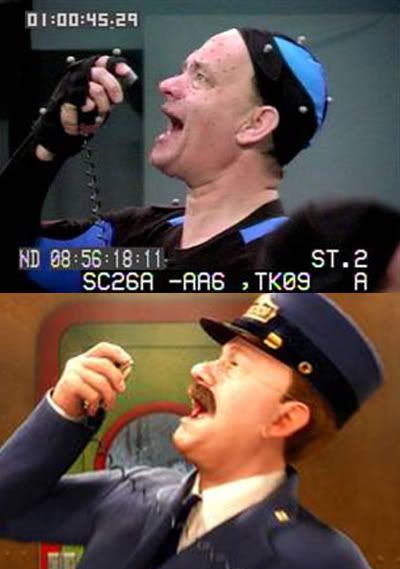
As you can see, the CG has completely sapped tom hanks’s emotion, dynamic and overall life giving acting from the character. As I have said before, the motion capture has not captured every muscle in the face therefore has left the image not photo-realistic. They seem to have made Tom Hanks’ character a bit fatter and more smooth than he is in real life.
I found out that Tom Hanks actually plays five different roles in the animation. This must play a massive part in why some of the characters do not look as real as they should. Hanks played the main boy, the boy’s father, the conductor, the hobo and Santa Claus.
For Tom Hanks to play the main child I found to be really weird as how Tom Hanks would speak and act would be completely different to a young child no matter how hard he acted.
“One of the first things I said to Tom was ‘I don’t think this would make a very good live-action movie.’ That was for a couple of reasons. One, I thought it would be impossible. Or it would cost billions of dollars. And two, you would be throwing away what I thought was the essence of the book, which were those paintings. The paintings are where the emotion comes from” Director Bob Zemeckis
http://www.agirlsworld.com/rachel/hangin-with/polarexteam.html
I don’t understand what the director says here as if he wanted the essence of the books paintings why didn’t he just do it in a painting style? Why did he go for the photo-Realistic style if he didn’t want it to look real?
Zemeckis says. "You'd have to find a kid who's as good an actor as Tom, and you'd have to keep him from growing for two years, because that's how long it would take to film." Standard animation, though, was also out of the question: Van Allsburg was opposed to it. So Zemeckis suggested blurring the lines and creating a stylized reality, or, as he labels it, "moving paintings."
http://www.agirlsworld.com/rachel/hangin-with/polarexteam.html
Looking through the book, ‘The Art of The Incredibles’, I came across some interesting quotes:"In my opinion it's always been a fallacy, the notion that human characters have to look photo-realistic in CG. You can do so much more with stylized human characters. Audiences innately know how humans move and gravity works, so if a human character doesn't feel right, they'll feel something's wrong. But if the weight works for stylized characters, the audience doesn't question it - like the Dwarfs in SNOW WHITE AND THE SEVEN DWARFS, which were so cartoony and stylized. In THE INCREDIBLES, the characters are cartoony heroes but they can be hurt and they have this family dynamic that makes them believable." Ralph Eggleston, Artistic Director for THE INCREDIBLES
There is so much leeway given to stylized human characters, that you look at photo-realistic digital humans, you will notice even the slightest of quirks. Here's another quote: "From the beginning, we all wanted the cast of characters to look like cartoon people instead of photo-realistic people. In animation, it really takes a bit of exaggeration to make something look convincing. The great caricaturist Al Hirshfeld most typified this. He could perfectly capture a person's identity by simply sketching curlicues for hair and pinholes for eyes. The faces and attitudes he drew were often more recognizable in the abstract than if they had been rendered out realistically." Teddy Newton, Character Designer on THE INCREDIBLES
To understand this more I decided to explore the techncal side of motion capture. I started by reading the book called ‘ The Animator’s Motion Capture Guide’. This book was extremely helpful, explaining the prosses of animation in motion capture. The art of motion capture is fairly new as it has only been around since 1980 although the first priciples of motion capture have been round since the 1800’s in the form of Eadweard Muybridge and Etienne-Jules Marey’s photographed animal study called the Zoogyroscope. The book explains that Motion Capture is more than a tool for animators as it is more of an art-form in it’s self.
I was surprised to find out that the animated TV show ‘Donkey Kong Country’ used motion capture and was also rejected from qualifying for an Emmy Award for best animated television series because the academy of television, arts and sciences said that it was not animation.
Alex Lindsay summed up this controversy best in an April 2000 article he wrote for 3D Magazine, Thinking Inside the Box; Kaydara’s Filmbox 2.0:
“As Motion capture has become more popular, many character animators have begun to think of motion capture as the anti-christ. They talk about its instabilities, lack of flare, and expense, but in reality, they see it as a threat to their livelihood”
I agree with this as I am an animator and the aspect of a computer doing my work 20 times faster than me is a daunting prospect. and before reading ‘The Animators Motion Capture Guide’ I was really against the idea of motion capture for animation. The reality of motion capture in the future is that it will be able to do 80% of the tedious animation letting the animators work on the most important parts of animation like the exaggerations. In present day motion capture techniques, the technology is still very new and very expensive to use, also you would need a master computer with the lastest graphics cards and processor power to run the motion capture data.
In conclusion, after comparing traditional animation to motion captured film I have found that the techniques and animation principles are completely different. Motion capture is like traditional animation’s evolutionary cousin. They both have the same traits including timing, weight and balance, personality and staging but they differ in the traits of Squash and stretch, exaggeration, follow through and overlapping. This gives both motion capture and animation unique qualities.
I think that motion capture would be unacceptable in some stories such as adaptations of some childrens books or traditional cartoons. If ‘The Incredibles’ was motion captured I believe the effects could have been disasterous. I think that if ‘The Polar Express’ was animated using traditional techniques it could have been just as successful. I now know that motion capture is an extremely technical process and has now presented itself as an artform.
Comparing two different artforms is extremely difficult and as they both have qualities that the animators of the future will need to progress their skills.
I have found that in researching and analysing the different animation styles I have learnt to appreciate motion capture rather than shun it as Rotoscoping has helped world famous animators, I believe that motion capture can only be benificial to any 3D animator.
Bibliography
Cotta Vas, M. The Art of The Incredibles. Chronicle Books. Nov 2004
http://blogcritics.org/archives/2004/10/19/140812.php
http://www.agirlsworld.com/rachel/hangin-with/polarexteam.html
Lindsay, A. Article: Thinking Inside the Box; Kaydara’s Filmbox 2.0 - 3D Magazine April 2000.
Liverman, M. The Animators Motion Capture Guide. Charles River Media INC.

No comments:
Post a Comment